Jennifer Reyes’ journey to the Windy City for both the spring and fall Chicago Half Marathons is anything but ordinary. A lifelong athlete and Registered Nurse from Queens, New York—“born and bred”—her connection to pancreatic cancer runs deep and unexpected. Between the two halves, Jennifer will use the streets of Chicago as a tribute to her past, a reminder of personal strength, and a way to support a cause she has made her own.
A Startling Discovery
In 2023, a cyst was discovered in Jennifer’s ovary, which was later ruled out as malignant. After undergoing surgery to address the issue, she developed an infection at her incision site, which required additional scans and tests. Coincidentally, one of those scans revealed something entirely unexpected: another cyst, but on her pancreas.
Though ultimately benign, the discovery was a wake-up call, one that set her on a new kind of health journey. Jennifer had always been athletic: “I played basketball since I was in diapers—basketball, softball, you name it,” she says. But running was always her least favorite part. She had been required to run during her military training in the Army, and she even tried running for weight loss in the early 2000s, yet it never stuck.
Her daughter, already a dedicated runner, encouraged Jennifer to join her at the gym. Jennifer had been easing into running here and there, but it wasn’t until the discovery of her pancreatic cyst that she fully committed to it, turning it into a serious and purposeful pursuit.
Hidden Connections
However, another twist of fate came when this personal pancreatic health scare occurred just a few years after she had reconnected with her biological family, discovering in 2019 that her father, whom she had never met, had passed from pancreatic cancer. The connection began when a distant relative reached out through a genealogical service, intrigued to learn more about Jennifer when she unexpectedly appeared on their radar.
It turned out the woman was Jennifer’s biological second cousin. Before learning Jennifer’s full story, she went to her grandmother and shared the information Jennifer had provided. Her grandmother realized, “Oh my goodness, that’s my brother’s daughter. Ask if her birthday is May 21st.” It was.
“It was a whole whirlwind,” Jennifer recalls. From there, she found out she had siblings, discovered who her biological mother was, uncovered the story of her parents’ young love, and began piecing together the broader details of her biological family. And as she learned more about this side of herself, she also quickly discovered that her biological father had passed away nearly twenty years earlier.
Hearing this news, Jennifer felt a mix of shock and sorrow, grappling with the reality that she would never have the chance to know the man who, in her own words, “gave me life.” Yet, she also learned about his character: how generous he was and how deeply he had longed to meet her before his untimely passing.
As she came to understand more about his battle with pancreatic cancer, the story became even more devastating. At the time, awareness and research were far more limited than they are today. By the time he showed symptoms and received a diagnosis, the disease had already progressed rapidly. “Apparently, when he got sick, his family didn’t even know,” Jennifer explains. “He was already on his deathbed before they even found out. They didn’t even get to say goodbye.”
The convergence of these two discoveries changed Jennifer in ways she couldn’t ignore. It connected her with her biological father, making his story feel personal and familiar. That wake-up call transformed running from a casual activity into a purposeful commitment, pushing her to run harder than ever, and with a meaningful cause in mind.
Falling in Love With Running
Running for Jennifer has had clear physical benefits, and she’s used to the effort it takes to stay in shape. After her health scare, running became a way to stay healthy and maintain the stamina needed for both her nursing career and daily life: a goal-driven practice that reinforced her sense of control over her body. “I’ve been running religiously ever since the doctor cleared me after surgery,” she says. “I literally run six days a week. Cardio is what does it for me.”
That drive pushes her every day, not to outpace anyone else, but to challenge herself. Jennifer gets up at 4 a.m. to run, crediting her military background for instilling the discipline to stay committed. She plans out her week in advance, and if the weather doesn’t allow her to run outside, she heads to the gym to get on the treadmill instead. “If I say I’m going to do something, I just do it,” she shares. “When I get up in the morning and look in the mirror, I tell myself, ‘Hey, I’m in great shape for my age, and this is what my dedication and my discipline has done for me.’”
She began participating in smaller, local races in her community, using them as goals to stay motivated and measure her progress. Her neighborhood plays a big role in keeping her committed. “There are a lot of people in this neighborhood that love to run,” she says. She even joined a run club. “The running community here is very big, so that helps because a lot of people share that obsession with me. They understand me!”
This was her routine for a while, until one day in 2023, she came across an ad for a virtual Turkey Trot with Project Purple. After her health scare, she had been researching pancreatic cancer and had noticed how people were running to support the cause. The idea had been in the back of her mind, but when she saw the ad, it immediately clicked; she knew she had to participate, for herself, for her biological father, and for others.
“I was like, you know what, why not do this for a cause that means something to me after doing tiny races in the neighborhood?” she recalls. She quickly completed Project Purple’s Virtual Events series, earning a medal for completing all three: the Turkey Trot, the Purple Paddy’s, and the Independence Day Double Mile. “As my husband says, ‘If you give me any reason to run, I’m gonna run,’” she laughs.
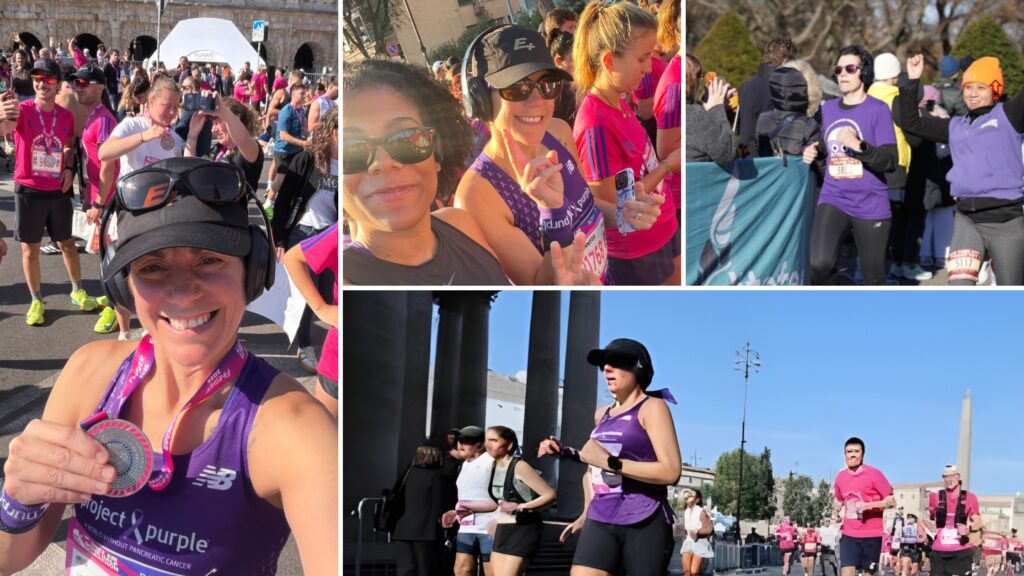
That felt rewarding, but Jennifer knew she wanted to take it further. In 2025, she decided to participate in something bigger, an in-person event that required being part of a team: the Rome Half Marathon. “And of course I picked an out-of-the-country one so I could make it a big deal! It was amazing,” she says. That experience showed her that running wasn’t just about fitness or competition: it could also carry deep personal meaning.
For Something Bigger
Running became Jennifer’s emotional outlet, extending beyond discipline and purpose to help her process life’s challenges and find balance amid stress. Last year was particularly difficult: her adoptive mother suffered a stroke in August, just before Jennifer was set to leave for Rome, and remained hospitalized until December. Tragically, her adoptive father also passed away that September. “If I didn’t have the running and all that discipline I was putting myself through,” she says, “I don’t know if I would have been able to cope.”
Jennifer describes herself as an emotional runner. “If I have a bad day, I’m gonna go run. If it’s a great day, I’m gonna go run,” she explains. “It’s very much a coping, emotional thing for me. Through all the challenges that have come my way, that’s been my outlet.” Rather than turning to unhealthy habits when faced with stress, anger, or sadness, she uses running as a way to care for both her physical and mental health.
The gratification she feels after a run only reinforces this. Having once genuinely hated running, Jennifer now not only can do it but loves it, giving her a significant boost in self-esteem. Being part of an organized team with Project Purple brings it all together: running helps her physically, supports her emotionally, and allows her to contribute to something bigger than herself.
After Rome, Jennifer knew she had to keep going. That’s when she decided to take on the Chicago Half Marathons, both the spring and fall events. Training for the two races might seem intimidating, but for Jennifer, “training is basically every day for me,” she says, so much so that it hardly even feels like training.
When it comes to race day, Jennifer’s excitement is palpable. It’s not just about running: it’s a celebration. “Every time it’s a big race like that, I just get really emotional,” she shares. “It’s definitely going to be great. It’s always an amazing thing. I always celebrate afterward.”
A Nurse, An Advocate, A Daughter
Jennifer’s work as a nurse adds yet another dimension to her running and her involvement with Project Purple. She has been a nurse since the 1990s, and her decades of experience in healthcare give her a unique perspective on the impact of pancreatic cancer. “You see it there, and you see it a lot,” she reflects.
While she works in the labor and delivery department, what many would think of as the happiest moments in life, Jennifer knows that nursing isn’t always easy. “Nurses are the worst patients,” she admits. “It’s the truth.” Having too much knowledge can make facing health issues even more frightening, and Jennifer experienced that firsthand with her own pancreatic scare.
Finding her pancreatic cyst was entirely by chance, and she remembers thinking how lucky she was that it was caught. “If something were ever to happen, or if it were to convert to cancer, at least I know it’s there and being watched,” she says. “Not everyone has that. And if something were ever to happen again, knock on wood, I at least know there’s a community I can turn to for support.”
Her experience stands in sharp contrast to her biological father’s, whose pancreatic cancer was detected too late for effective treatment. Today, research is opening new possibilities. “Look at breast cancer—people beat it all the time,” she says. “Eventually, we can say that people beat pancreatic cancer all the time. There are survivors, and we’re getting there, and that’s great.”
The difference between her early detection and her biological father’s experience highlights the importance of catching issues before they become serious. Working in the hospital, Jennifer sees firsthand the difference timely intervention can make, and she wants to help that change happen in real time. “We need more people saying, ‘I beat it!’ Why should you have to wait until you go in for something else to find out there’s a problem?” Fundraising for the race has been her way of helping make that a reality, and she is especially grateful for the support of her colleagues who have donated to her page. “You get to see who’s really behind you,” she adds.
She hopes that through awareness and research, others will have more hope and access to care: opportunities her biological father unfortunately never had. “To me, this is in honor of him,” she says. “He never had the opportunity to even see his own kids grow up. He gave me life, and he didn’t get a chance to ever meet me, so at least I can say I know him, even though he never knew me.”
Jennifer encourages anyone to get involved with Project Purple. She notes that for athletes, there’s nothing better than joining an organization that celebrates every milestone in the fight to find a cure. “You can donate to a charity,” she says, “but they’re a community. They host events, raise money, and actually help people.” Beyond that, she adds, being part of Project Purple gets you moving, and inspires others to move too, staying healthy while making a difference.
Jennifer laughs as she sums it up: “I have the determination to keep going, and nothing is going to stop me from staying in shape. They’d have to chop off my legs to get me to stop running!” But it’s more than just stubbornness or fitness. Every mile she logs is a tribute: to her own health, to her biological father, and to the broader fight against pancreatic cancer.
To support Jennifer’s run and to help raise awareness for pancreatic cancer, donate to her fundraising page here.
If you’d like to run or participate in an event of your own for Project Purple, visit our events page.