
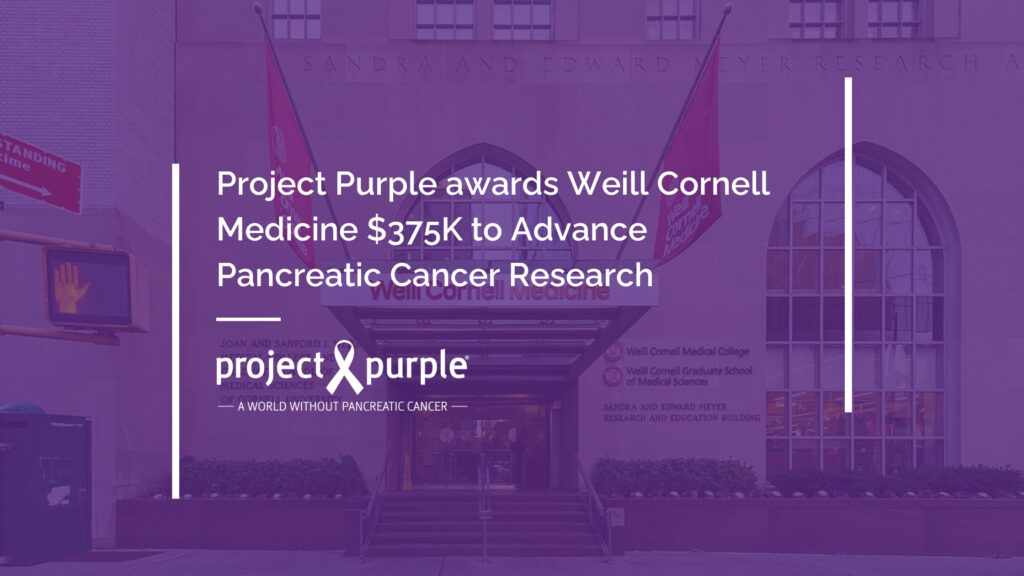
New York, N.Y. — Project Purple has invested $375,000 to support pancreatic cancer research at Weill Cornell Medicine. This two-year Research Recovery Grant will sustain critical research following a recent funding gap, ensuring continued progress in pancreatic cancer investigation.
“Our goal is to keep the science moving. In the current environment where grants were cut by the federal government, which funds 80% of cancer research within the U.S., the Project Purple grants are designed to bridge funding gaps and ensure that promising research programs can continue without interruption,” said Dino Verreli, CEO and founder of Project Purple.
The study is led by Dr. Despina Siolas, MD, Ph.D, a medical oncologist and member of the Sandra and Edward Meyer Cancer Center at Weill Cornell Medicine.
“One of our biggest goals is to have the greatest impact with every program, and we feel this is the way we can have the greatest impact with our research program in order to keep making progress,” Verrelli said.
Study Objectives and Strategy
Pancreatic ductal adenocarcinoma (PDAC) remains an intractable disease with a poor survival rate. It is the most common and fatal form of exocrine pancreatic cancer.
Dr. Siolas and her team are investigating how tumors create fibrotic and immunosuppressive barriers, which stop chemotherapy and immunotherapy from reaching cancer cells. As a result, these cells are resistant to standard treatments.
Data gathered during this study shows that different tumors have varying identities depending on their genetic makeup. A central focus of the study is KRAS, a gene mutated in over 90% of pancreatic cancers. Importantly, distinct KRAS mutations—such as G12D, G12R, and G12C—are increasingly recognized to drive different biological behaviors, including how tumors interact with their microenvironment.
The team hypothesizes that certain versions of the KRAS mutation create unique environments that require different medical approaches. This is often why some patients respond to certain treatments while others do not. Weill Cornell is researching how matching a patient’s particular KRAS mutation to a specific therapy could make treatment more successful.
To investigate this, the team will analyze pancreatic tumors in both mice and human tumor samples, creating experimental models that reflect human cancer and can be leveraged for more precise and effective therapies.
“Every grant we award represents hope for researchers, for patients, and for families affected by pancreatic cancer,” Verrelli adds. “We’re proud to help ensure these projects continue to move the field forward.”

Dr. Despina Siolas, MD, Ph.D.
Leading the way on this study is Dr. Siolas, who has been an Assistant Professor of Medicine at Weill Cornell Medicine since 2021. She is a rising leader in the gastrointestinal oncology field, with clinical expertise and insight to drive new treatment strategies for pancreatic cancer forward.
She leads a laboratory focused on the intersection of cancer genetics, tumor immunology, and therapeutic resistance. Her work aims to translate insights from tumor biology into novel therapeutic strategies, particularly for pancreatic cancer, where new approaches are urgently needed. She has received multiple competitive research awards and has contributed to advancing the understanding of key oncogenic drivers, including KRAS and TP53.
About the Research Recovery Grant
With a particular focus on Early-Stage Investigators (ESIs), these awards are designed to help emerging investigators sustain momentum as they establish independent research programs, preventing disruptions that could slow progress in pancreatic cancer research.
Project Purple considers research projects across all areas of study, including basic science, translational studies, clinical research, and population science. Project Purple’s Multi-Disciplinary Research Committee selects awardees.
For researchers looking for future grant opportunities, please continue to monitor projectpurple.org/grants.
About Project Purple
Founded in 2010, Project Purple is committed to creating a world without pancreatic cancer while improving care and outcomes for patients and their families. Since its inception, the organization has invested over $5.5 million in research, with a strong emphasis on early detection initiatives, including. Foundational funding for Hartford HealthCare’s High Risk Pancreatic Cancer Screening Program, multiple studies at Duke University School of Medicine, and numerous other groundbreaking projects.
In addition to research, Project Purple has awarded more than $1.5 million in patient aid, allowing over 1,500 patients & families to focus on treatment and care rather than financial stress.
To learn more about Project Purple, visit projectpurple.org/about.