
“In medicine, you want to help people, but sometimes the biggest difference you can make isn’t physical. It’s emotional.”
That belief shapes how Benjamin Oliver moves through his days.
At 3:15 a.m., long before sunrise, his day begins. Both Benjamin and his wife embrace the early hours, carving out time for their morning workouts. By 4 a.m., he’s at the gym, fitting in his daily run before the rest of the world stirs.
Mornings are the only time that reliably works for him. With two kids and a full hospital schedule, consistency matters, and for Benjamin, that consistency starts before sunrise. “I’ve always been an early bird,” he says. “It’s the most dependable time I have. I have to knock it out then.”
He used to hate running on the treadmill, but winter weather in Georgia has forced a compromise. The miles still get done, and the routine still holds. And when the run is over, the pace of the day shifts quickly from solitary to shared.
Back home, he helps with breakfast and morning logistics. His wife, a teacher, manages most of the morning routine, being the “house manager,” as Benjamin jokingly calls her, but they tackle it as a team. One child heads to school with her, while Benjamin takes the other before turning his attention toward work.
By 7:40 a.m., he’s walking into Erlanger Hospital in Chattanooga, Tennessee, where no two days look exactly the same. As a Physician Assistant in Gastroenterology, Benjamin works inpatient, collaborating closely with attending physicians, fellows, and residents. Right away, he reviews the patient list: Who’s been admitted? Who needs to be followed up with? What requires attention first?
Much of his work involves patients dealing with complex Gastrointestinal (GI) conditions, including pancreatic cancer. He often works alongside advanced endoscopists during procedures, primarily observing as they carry out critical tasks for diagnosis and treatment. Some days involve these observations; others are spent coordinating care, adjusting plans, and addressing questions without clear solutions.
The hours stretch or contract depending on what his patients need. Some days he leaves in the early afternoon, and others run well into the evening. The unpredictability is part of the job, and part of the emotional reckoning that comes with it.
“In medicine, you do have to separate yourself sometimes,” Benjamin says. “Otherwise, it can bog you down.” But separation doesn’t mean detachment. For Benjamin, it means learning how to hold empathy without letting it consume him: how to care deeply without losing himself in the weight of it all.
That balance carries over into the rest of his day. Evenings are filled with practices and carpools, basketballs and baseballs, dance bags and homework. He and his wife trade off, one at home, one at practice, doing their best to keep everything moving. It’s hectic, but full of the moments that make their family who they are.
Running, Benjamin has found, helps him stay grounded and present.

When the Miles Start to Mean More
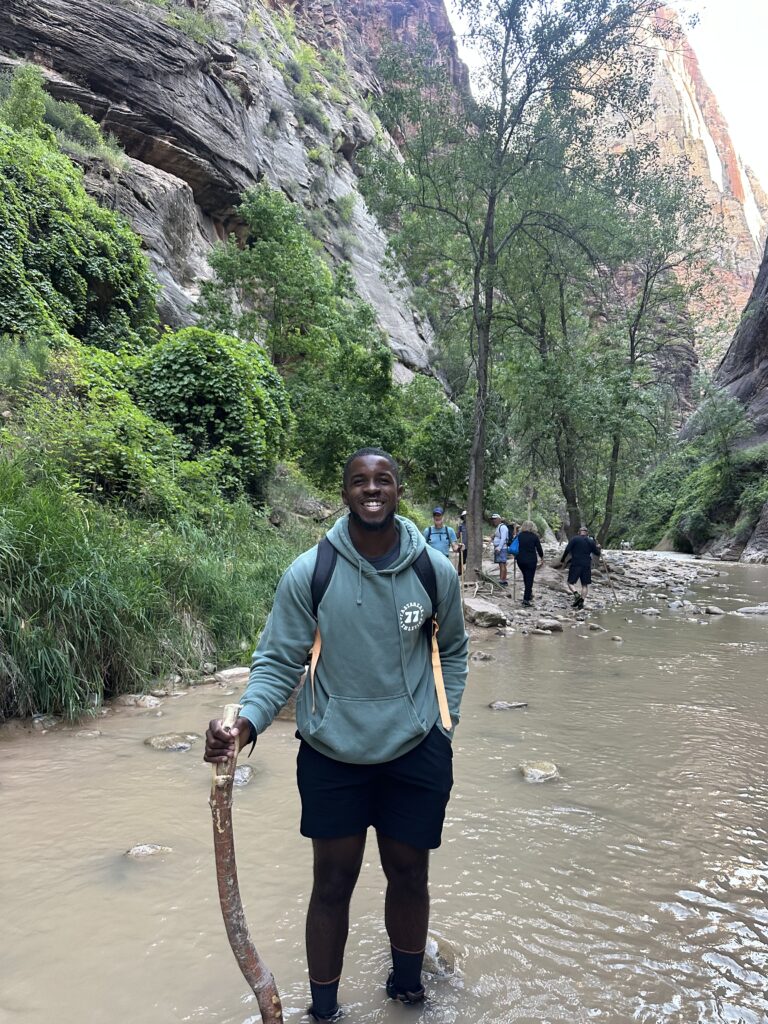
Benjamin didn’t always see himself as a runner. Before 2020, it wasn’t even something he enjoyed. But when the pandemic shut down gyms and routines disappeared, running became one of the few accessible ways to move. “I was like, ‘I guess I’ll do it,’” he laughs. “I definitely wasn’t a fan before that.”
Over time, though, something shifted. The solitude, rhythm, and quiet competition, sometimes with others, but more often with himself, really stuck with him. “It’s just peaceful,” he says. “For the most part, it’s just you. It’s the perfect balance.” What started as a workaround slowly became a constant, one that would eventually open the door to something much larger than miles alone.
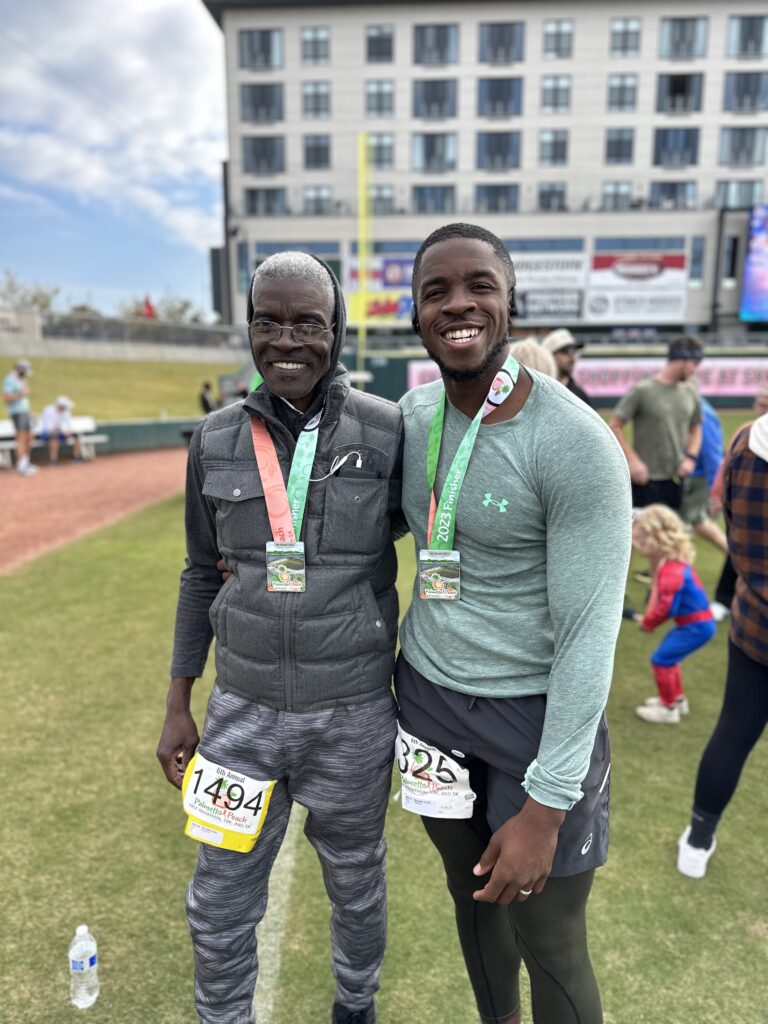
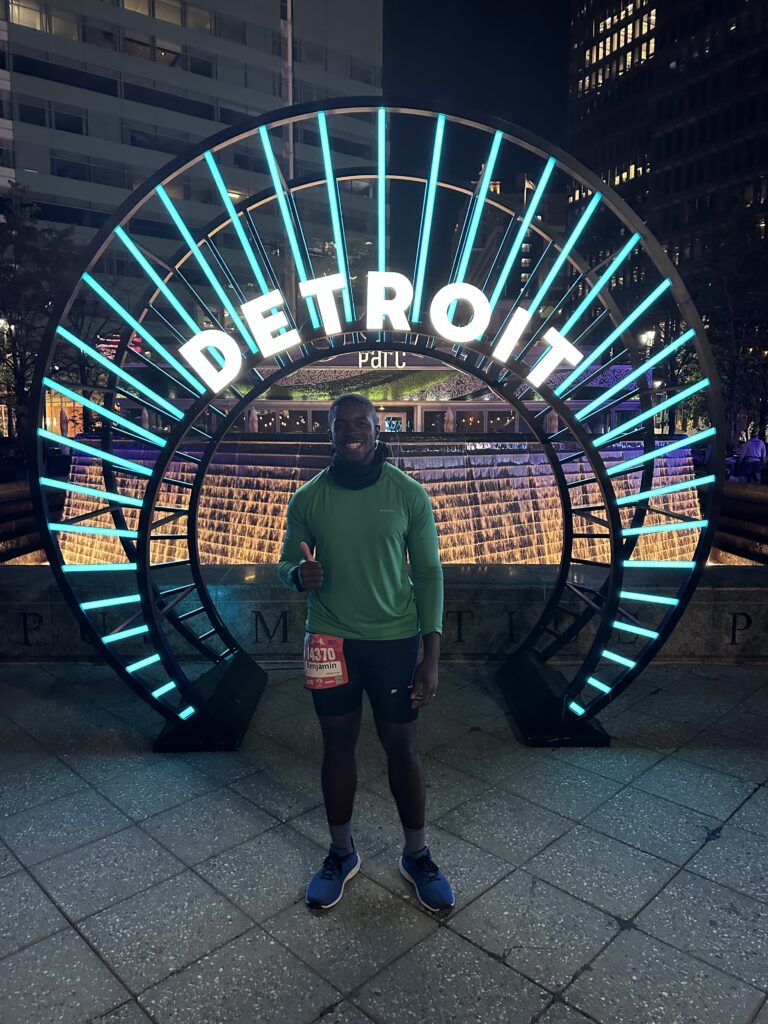
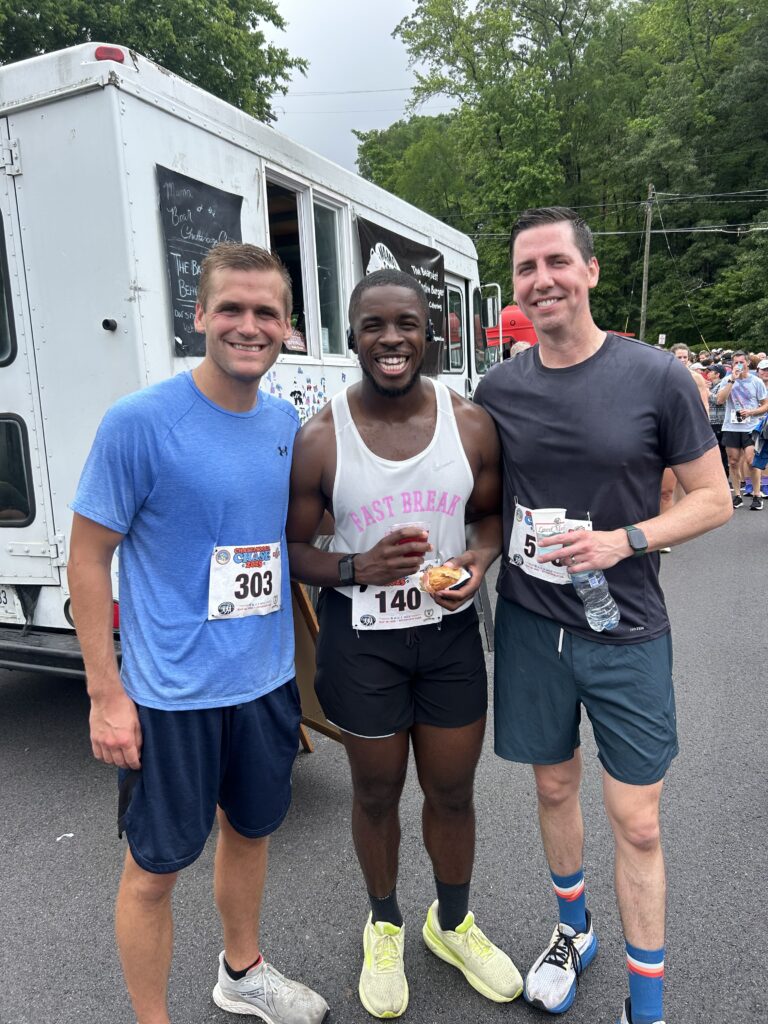
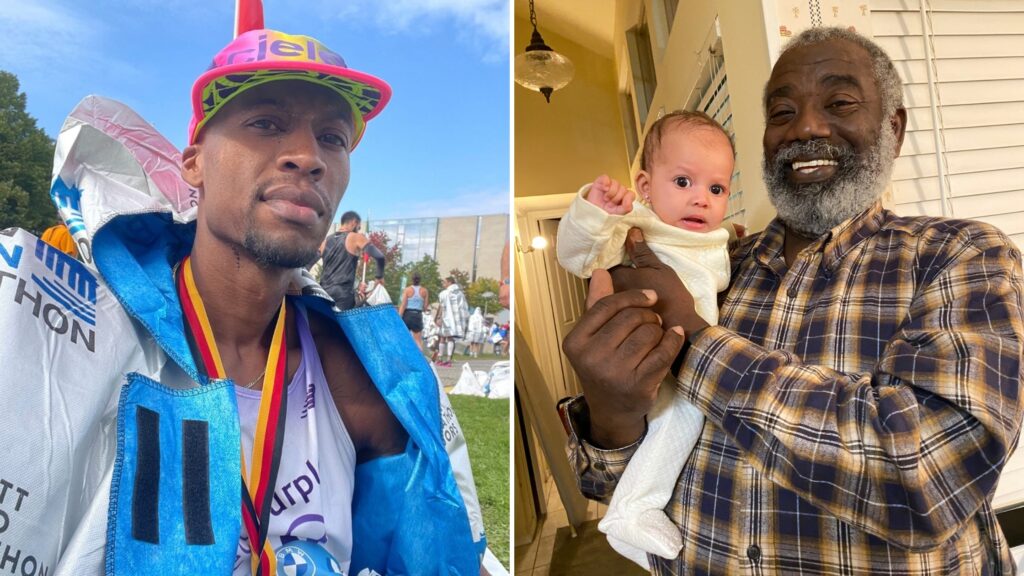
Over time, organized races followed, including half marathons. Different cities. Different crowds. Different rhythms. Somewhere along the way, a goal took shape: to run a half marathon in all 50 states. He has now completed eight and counting.
For a while, that was enough. Running was personal, something he did for his own clarity and challenge. But that all changed after a conversation with his sister. “She asked me, ‘Do you even know what you’re running for?’” he recalls. “I was like, ‘No, I just like running.’”
The question lingered longer than he expected. As someone who spends his days immersed in medicine, specifically gastrointestinal care, it felt odd to treat running as something entirely separate from the rest of his life. He began looking more closely at the races he was signing up for, not just where they were, but what they stood for.
He wanted his running to reflect the work he was doing every day in the hospital. That search led him to Project Purple, a non-profit focused on pancreatic cancer and its impact on patients and families. “I kind of just stumbled upon it,” he says. “But it was a perfect pairing.” It wasn’t simply about running for a cause; it was about running with one: a team, a community, and a shared purpose.
For Benjamin, pancreatic cancer hit closer to home than he initially realized, not through any personal family history, but through the great presence he has noticed it has in his daily life as a PA. “Working in GI, especially inpatient, you see it a lot,” he explains. “You see how often it comes up, and how much it affects patients and their families.”
That proximity made the decision feel less like a choice and more like an extension of who he already was. Running no longer existed apart from his work; it became another way to engage with it and carry awareness beyond the hospital walls.
This June, Benjamin will run the Gary Bjorklund Half Marathon in Minnesota as part of the Project Purple team, joining runners from across the country who are united not just by distance, but by purpose. For him, the race isn’t about time or placement. It’s about representation: about showing up for a disease that often goes unseen. And for the first time, the miles mean something more than just forward motion.

Running to Make the Invisible, Visible
Pancreatic cancer, Benjamin explains, is different. “It’s sneaky,” he says. “Some cancers give you signs and symptoms that tip you off early. With pancreatic cancer, by the time those symptoms show up, it’s often too far gone.”
In his role in gastroenterology, that reality isn’t theoretical; it’s routine. He sees it in consultations, imaging, procedures, and conversations that happen too late in the disease’s progression to offer easy answers. Often, the diagnosis arrives in a single, overwhelming moment.
What makes it even more unsettling, he says, is how the disease is changing. “It used to be older patients, in their 70s or 80s,” he explains. “But now it’s getting younger.” He reveals that he just met with a patient who was 54, already with advanced and metastatic pancreatic cancer. The shift isn’t subtle. It’s happening in real time. Recently, he shared that he had three new patients diagnosed with the disease in four days.
However, there have been moments of optimism. Benjamin recently cared for a patient who has been living with pancreatic cancer for two years: an outcome that reflects real advancements in treatment and therapy.
For Benjamin, running with Project Purple is a way to extend his different impact, not as a clinician with a chart, but as a person choosing to act outside the hospital. “Working in the hospital, you see how much pancreatic cancer affects not just patients, but families,” he says. “Running for something that brings awareness and helps push research forward, that’s something I’m all for.”
What makes the Gary Bjorklund Half Marathon particularly meaningful is not just the race itself, but the community surrounding it. Through Project Purple, Benjamin has connected with survivors, caregivers, and family members whose experiences add dimension to what he sees clinically.
“When we have team calls, and you’re hearing stories, whether it’s survivors or families, that hits a lot closer to home,” he says. “It reminds you that these are people, not just diagnoses.”
That reminder has followed him back into the hospital. “I was in the lounge one day, and another PA mentioned he had pancreatic cancer,” Benjamin recalls. “He was wearing purple, it was November, and we started talking. Nobody usually broadcasts that.”
Moments like that have reframed how Benjamin understands the reach of the disease. Pancreatic cancer, he’s learned, isn’t confined to exam rooms or inpatient floors. It exists quietly among coworkers, friends, and strangers, often unspoken and invisible.
“There are people all around us who’ve been affected,” he says. “You just don’t always know. It surprised me, but it’s great to realize there’s a community out there, and sometimes it only takes one person to help bring that community into the spotlight.”
Running for Project Purple has given him a way to acknowledge that hidden community and make space for recognition in a landscape where pancreatic cancer too often goes unnoticed. And for the patients he sees every day, that recognition matters.
Making a Change Beyond the Hospital
Benjamin understands how isolating a pancreatic cancer diagnosis can feel. “Just having someone who’s aware, who understands the significance of what you’re going through, can make a huge difference,” he says. “It doesn’t fix everything, but it helps people feel supported without having to explain every detail or relive the helplessness.”
With a deeper connection to his pancreatic cancer patients, he carries that same commitment beyond the hospital, using it to raise awareness and support the cause. Every week on social media, Benjamin highlights something related to pancreatic cancer: last week he shared information about Project Purple in general, the week before that he focused on symptoms, and the week before that he discussed prevalence and diagnosis.
“Awareness is a huge part of Project Purple’s mission, and sharing information like this is a way to contribute,” he says. “It can be challenging, but it’s also rewarding to have that added purpose.”
Raising money has been meaningful as well, especially knowing that pancreatic cancer receives relatively little research funding. “You can’t do research if there’s no funding,” Benjamin says. “So being able to raise funds, no matter the cost, to support research, that’s something I’m all for!”
It’s been humbling for Benjamin to learn about people’s stories and personal connections. For example, one of his coworkers’ fathers has pancreatic cancer, and the support people have shown through donations to his fundraising page has made the impact of the disease feel more personal to him. “It’s been grounding,” he says. “I hope that comes through when people see me running. We see them as people, and we’re rooting for them, hoping for the best.”
Benjamin’s main message is simple: anyone can make a difference. He never imagined he’d be working in GI, let alone combining that work with running for a cause. “If you’re willing, if you have a passion, or even if you just want to step outside your comfort zone, do it,” he says. “People appreciate you stepping up and making an effort. Every little bit helps, whether it’s raising awareness, supporting research, or just showing you care. That’s the big thing for me.”
To support Benjamin’s run to help raise awareness for pancreatic cancer, donate to his fundraising page here.
If you’d like to run or participate in an event of your own for Project Purple, visit our events page.