For Emily Bierman, running has been a constant presence in her life: from middle school, through college competition, and into marathon running in her adulthood. But in recent years, it had taken a backseat to raising her three young daughters and building a life centered around family.
Now, for the first time in six years, she is returning to the marathon distance, taking on Grandma’s Marathon in Minnesota, her home state. This time, she isn’t just running for a personal milestone. She’s running for someone who has quietly become part of her family’s life: her daughter’s preschool teacher, Sue Bergquist, a pancreatic cancer survivor whose strength has left a lasting mark on her daughter, and on Emily herself.
How Running Took Hold
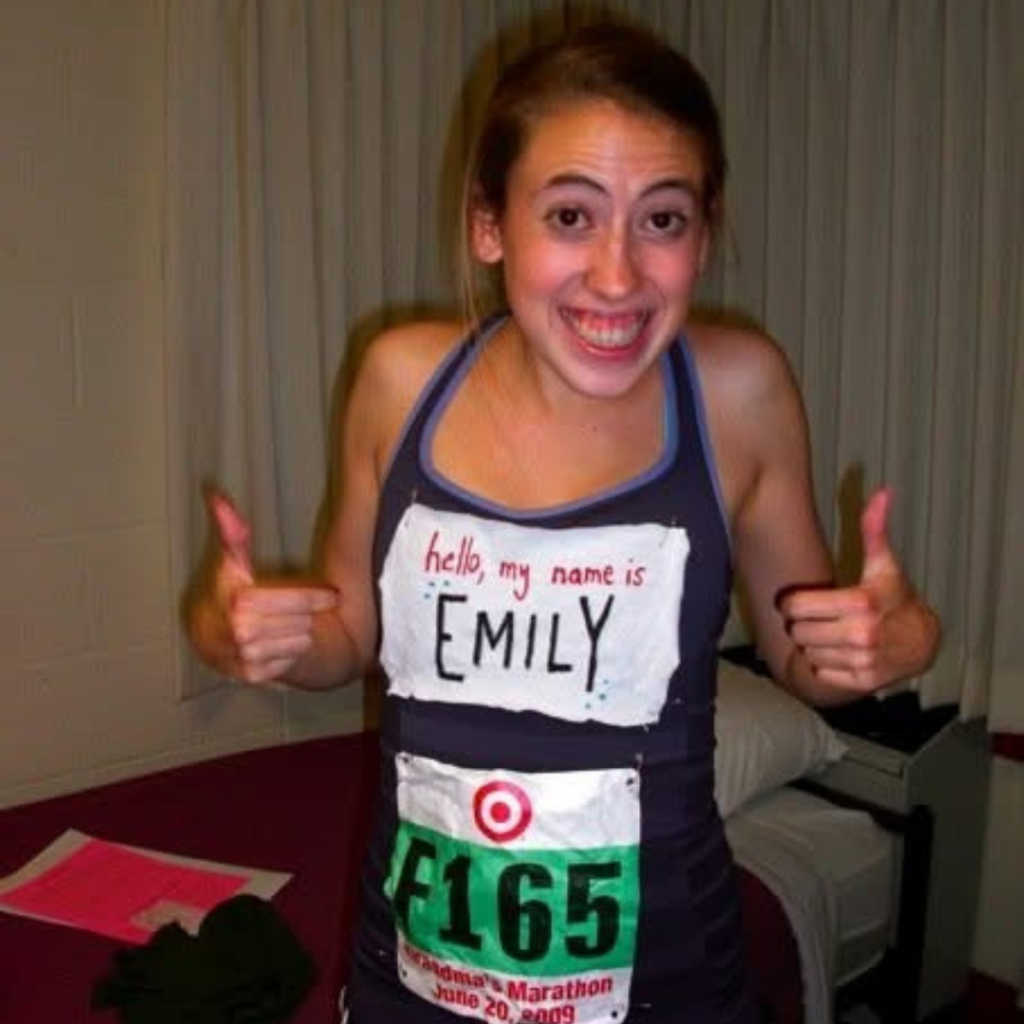
Emily Bierman’s relationship with running began almost by accident. In seventh grade, she lost a bet with her father and, as a result, had to join the cross-country team. What started as something silly, lighthearted, and a little reluctant became something far bigger than she ever expected.
She admits that at the beginning she struggled with a lack of flexibility and coordination, but quickly realized that “running was really the only shot I had to be athletic.” It wasn’t easy, but it gave her something important: a clear link between effort and improvement. “If you keep doing it, it does get easier,” she says. “And I appreciated that.”
She kept going. She worked hard, saw herself improving, and stayed with it. Emily continued running through high school and into college at Kenyon, where she competed in cross country and track. By the time she graduated, running had become so embedded in her identity that stepping away didn’t feel natural. “I didn’t know how not to race,” she explains.
So, shortly after college, she signed up for her first marathon: Grandma’s Marathon in 2009. That first race led her down a path of falling in love with the marathon distance. Over the years, she went on to complete several more, including races in Boston, Philadelphia, Twin Cities, Hartford, and Ontario. But eventually, life shifted.
After college, Emily got married and had children, and the structure of her days changed completely. Running didn’t disappear, but the marathon training cycle, with its long weekend runs and hours of preparation, became harder to maintain. “I didn’t want to take away hours of our family time to go for a run,” she says.
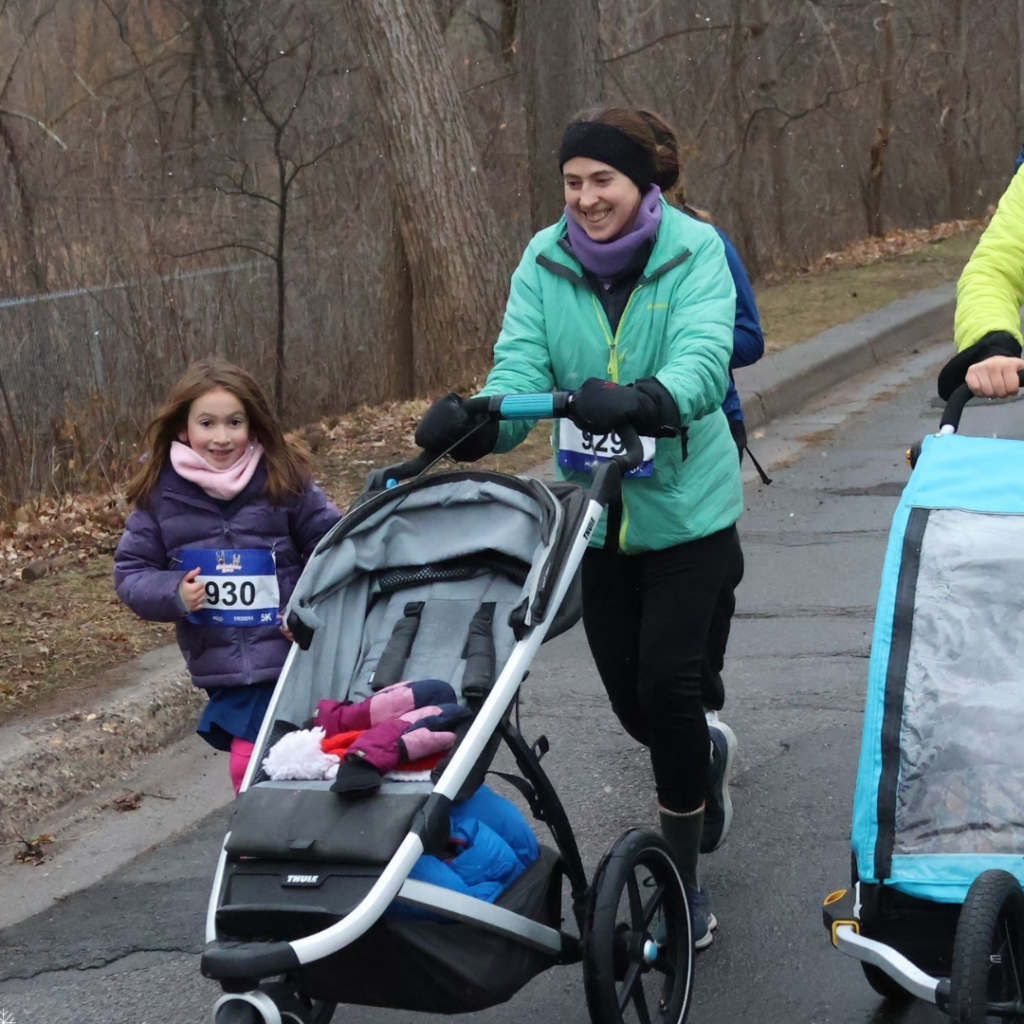
Still, she found ways to stay connected to it. She ran with a stroller, squeezed in short runs when she could, and held onto it as something personal and grounding. “You can tell the days that I don’t run from the days that I do,” she says. “It’s where I process everything.” It’s a moment when she can feel her body as her own again with the demands of motherhood. “It’s a really important part of my identity and who I am,” she adds. “I feel stronger when I run.”
For a long stretch of time, that was enough. Running became less about training and racing, and more about maintenance: something steady in the background of a busy family life. But over time, even that rhythm began to pause. It wasn’t until years later, when her youngest daughter started preschool, and a new connection entered her life, that running began to shift again from something she did occasionally to something she started to imagine returning to in a new way.
The “Cora Whisperer”
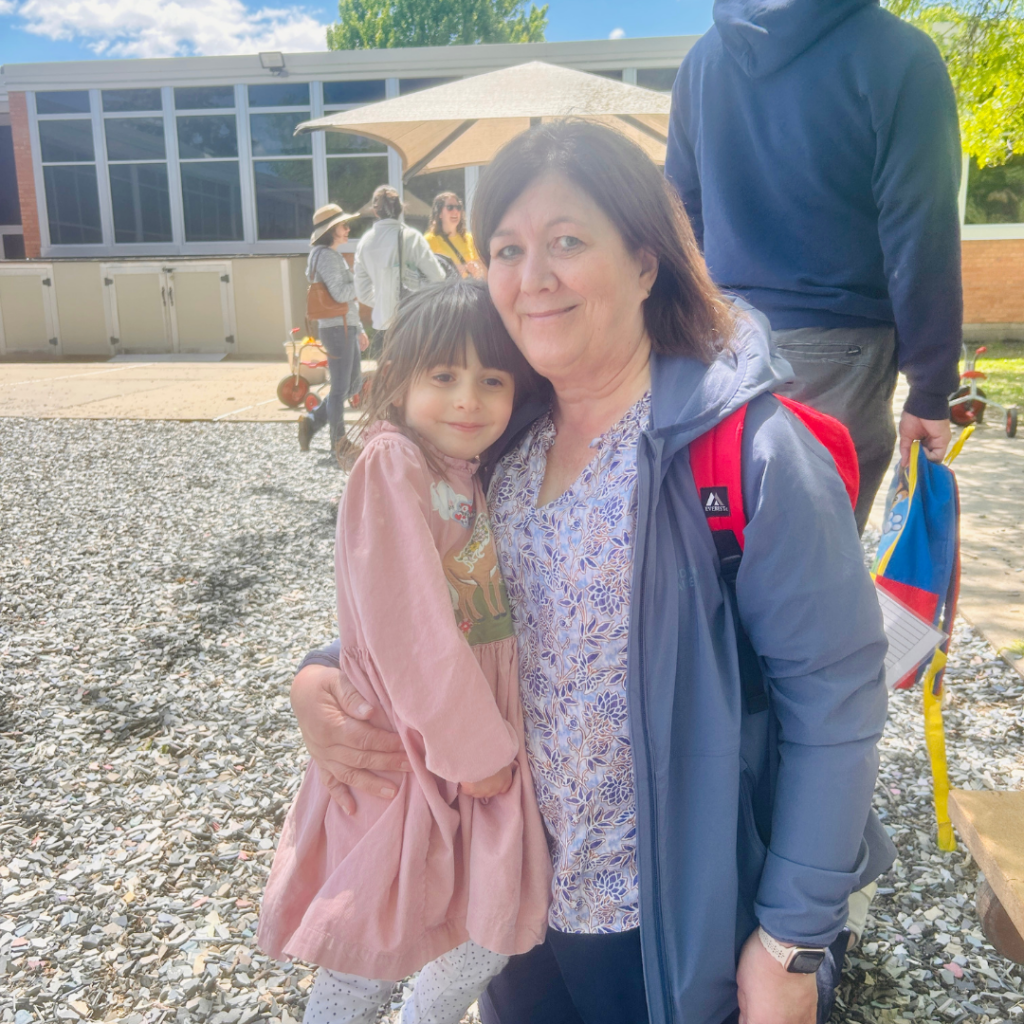
Emily first met Sue through her daughter, Cora, who was in her preschool class. Like many parents, Emily approached that first drop-off with a mix of hope and uncertainty, especially with Cora, who she describes as “funny and witty,” but also “a little bit sassy.”
“I was so nervous,” Emily laughs. “I thought I might not be able to leave the parking lot without getting a call to come pick her up.” That call never came. Instead, something clicked almost immediately.
Sue has a way of connecting with her students that feels both effortless and profound, and with Cora, it was especially clear. “She just got her,” Emily says. “She understood her.” At home, that impact became visible in small but meaningful ways. One phrase, in particular, stuck: “smell the flowers, blow out the candles,” a simple breathing technique Sue used to calm her students. Emily now finds herself using it in her own life. “I can’t tell you how many times I’ve used that as an adult,” she says.
Sue’s presence in the classroom was defined by a quiet steadiness: calm, patient, and deeply attentive. “She has this ability to see children for who they are and respect them,” Emily says. It’s what led her to jokingly call Sue the “Cora Whisperer”—having a peaceful and kind presence in such a subtle, beautiful way that helps spark the kids’ creativity and excitement.
But it wasn’t until later in the school year that Emily learned something that reframed everything she thought she knew about her. Sue mentioned, almost in passing, that she had missed a day for a medical scan and that she had been cancer-free for four years. “We talk every day at the playground,” Emily says. “And so we’d gotten to know each other, and then I heard about her cancer. I was just floored by that.”
From there, Emily began to understand more of Sue’s story. Sue had been diagnosed in October 2019 after developing jaundice, a symptom that led to further testing and ultimately a Stage 2 pancreatic cancer diagnosis. What followed was an intense and grueling year: chemotherapy, radiation, and a 13-hour Whipple procedure.
After taking a year to undergo treatment and recover, she returned to the classroom. “I’m in awe of that,” Emily says. Having also been a teacher herself, she understands just how demanding the job is. “To come back to it after all of that—it’s incredible.” Now that they’ve become closer friends, Sue keeps Emily updated after every scan, continuing to share her journey in real time.
Throughout her treatment, Sue had been supported by her own community: families from the preschool where she was teaching at the time organized meals, provided hospital parking passes, magazines for chemo sessions, grocery and gas cards, and raised funds to support her. It was a network of care that carried her through one of the most difficult periods of her life.
Years later, Emily would find her own way to contribute to that same spirit of support.
A Marathon Reimagined
The idea to run another marathon didn’t come from a single moment; it built gradually. Emily had already decided that turning 40 would be marked by something meaningful, and returning to the marathon distance felt like the right way to do it. “It had been a long time since my last marathon,” she says. “And the timing just felt right.”
And Grandma’s Marathon, where her marathon journey first began, felt like the natural choice. Set along the shores of Lake Superior, it’s known not only for its beauty, but also for the strong sense of community among runners who travel from all over to take part: an appeal that felt even more meaningful after Emily spent years living on the East Coast and later moved back to Minnesota.
She signed up independently as a birthday milestone celebration and got into the race on her own. But soon after, she began to wonder if the race could represent something more. “I thought to myself, ‘How can I make this more meaningful?’” she remembers. Her mind immediately went to Sue.
Emily was no stranger to pancreatic cancer organizations. After she first learned about Sue’s journey with the disease, she and her family began participating in pancreatic cancer walks over the years. And whenever Sue would share that she had received a clear scan, Emily and her family would donate a little more to pancreatic cancer charities.
So even though she was already confirmed in the race, Emily knew she wanted to continue that thread of support in a more intentional way, bringing it directly into her marathon. That’s when she found Project Purple on the marathon website, and it all fell into place. Emily then asked Sue if she would be comfortable with her dedicating the run in her honor, and she quickly gave her the go-ahead.
That decision transformed the experience. Training was no longer just about mileage or pace. It became tied to something larger. On the hardest days, especially during a brutal Minnesota winter filled with snowstorms and 50-mile-per-hour wind gusts, Sue’s story stayed with her.
“She’s so strong for what she went through,” Emily says. “When she told her story, it was very much like, ‘I knew this would be hard, and I did it.’” And that mindset became something Emily carried with her: a quiet reminder that difficult things can be faced one step at a time.
Training also became a shared experience. Emily runs with another preschool mom, coordinating schedules around their families and finding time wherever they can: early mornings, cold afternoons, even the occasional reluctant treadmill session.
And at 40, Emily has found that the training process feels different than it did a decade ago at 30. “I’m not running at the pace I once ran,” she says. “But I’m enjoying it just as much. I’m learning to not always care about the time, but to just enjoy the process and the connections that I’m making.”
Where Support Becomes Strength
As race day approaches, Emily knows the experience will be both physically demanding and deeply rewarding. “It will probably feel painful,” she laughs. “But also really great.” The energy of marathons is something she is especially excited to return to, citing the joy and camaraderie as what makes them so meaningful to her.
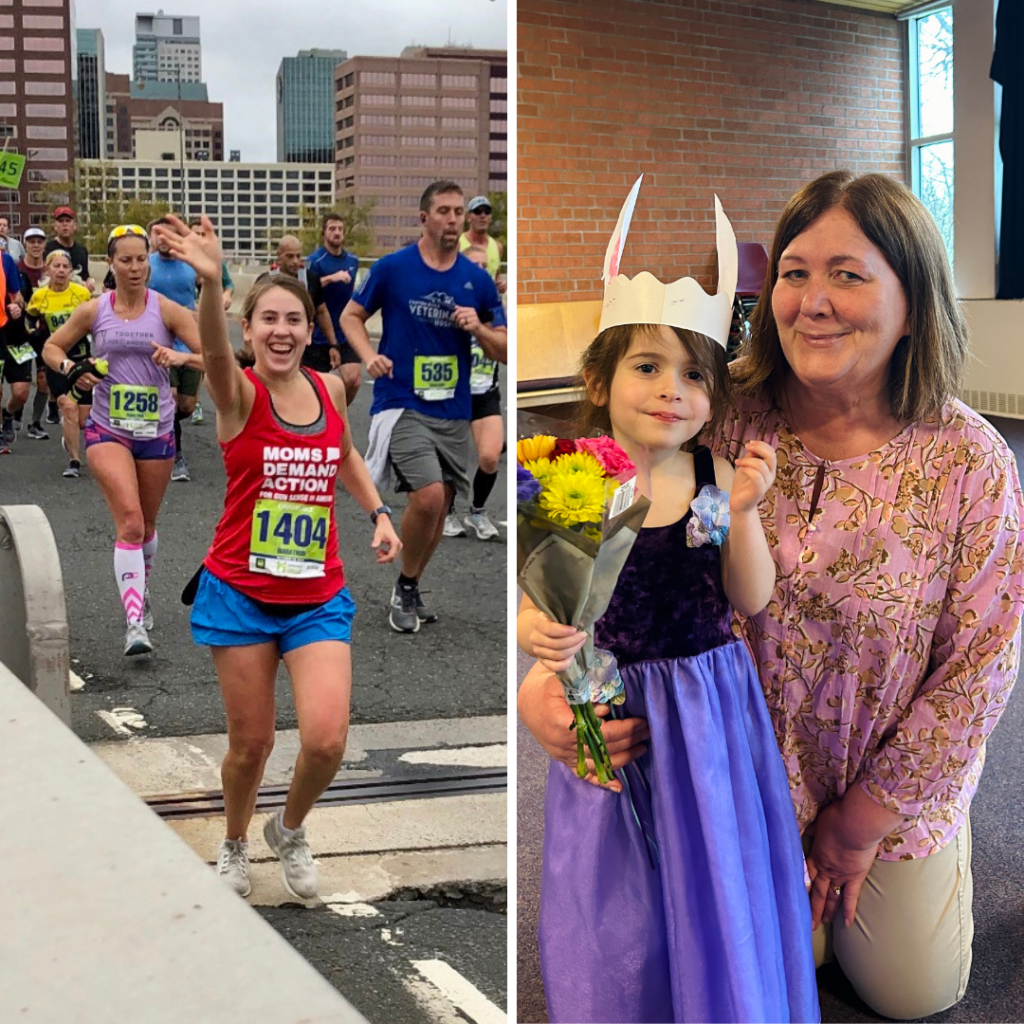
But more than anything, crossing the finish line will represent something personal: a return to a part of herself she had set aside, and proof that it’s still there. And she hopes her daughters take something from that process. Just as they are watching her return to running after a long pause, she sees Sue’s story as another example of resilience worth noticing.
“We’re all going to go through challenges in our lives, some harder than others,” Emily says. “But you just have to go through it. And as my husband and I tell our kids, you can do hard things. One step at a time.” For Emily, that mindset is rooted in something larger than running: community.
“As I get older, I realize how much more we need each other. We’re all in it together. And it’s about showing up for the people in your life, trying to make their lives easier, and knowing that at some point, you’re going to need them too,” she shares. And as her daughters grow older, Emily hopes they carry that with them, perhaps even running alongside her in the years to come.
That sense of community has shown up in tangible ways throughout her training. Families in Cora’s class have donated to her fundraising efforts, often leaving thoughtful notes alongside their contributions. Many have since moved on to different elementary schools, but the connection remains. Across all of them, the same sentiment comes through clearly: Sue is an extraordinary teacher, and they would do anything to support her.
Beyond fundraising, though, the run represents something bigger: an effort to carry forward the kind of support that once surrounded Sue during her treatment. Through her campaign, Emily is helping raise money for pancreatic cancer research and supporting patients and families facing the same diagnosis. “As a society, we need to try to make the world a better place for all of us,” she says. “There’s so much that needs to be done, but there’s also hope.”
Sue’s story is a testament to that hope. Now six years cancer-free, she represents what is possible when treatment, resilience, and support come together. “I just feel lucky that I get to do something,” she shares. “That I’m not just running for myself, but trying to help in some way.”
Sue is deeply moved by that support. “It’s an honor that Emily and her family have chosen to donate money in recognition of me and raise money and run the race,” she says. And while Sue remains humble about it all, Emily knows the impact is real and appreciated. “She will be cheering me on in spirit,” she says.
Her advice for others is simple: start. “Just sign up,” she says. “You can do hard things.” Because sometimes, the most meaningful acts of support don’t come from lifelong relationships or grand gestures. Sometimes, they come from small, everyday connections: from conversations at pickup, from shared moments on the playground, from recognizing someone’s strength and deciding it deserves to be honored.
To support Emily’s run in honor of Sue and to help raise awareness for pancreatic cancer, donate to her fundraising page here.
If you’d like to run or participate in an event of your own for Project Purple, visit our events page.